
We prioritize clinical research so that you can rest assured our products are efficacious at the recommended dose.
Clinical trials—that is, randomized, placebo-controlled experiments involving human participants—are key for verifying whether a product has the intended effect claimed on the label.
Results from our in-house clinical trial on the core ingredient in our formulations, boswellia, are outlined below along with additional supporting research for the other ingredients contained in our products.

Science of our ingredients
- Boswellia serrata
- Bacopa monnieri
- Panax ginseng
- Lutein
- Vitamin D
- Vitamin C

Bacopa monnieri
A recent, randomized, double-blind placebo-controlled clinical study on 60 healthy elderly subjects (mean age 62.6 years) received either a standardized extract of Bacopa monnieri or placebo once daily for 12 weeks. Results showed that the Bacopa monnieri extract improves attention, brain function, and memory[1].
Similarly, another randomized, double-blind placebo-controlled clinical study on 48 healthy elderly volunteers (mean age 73.5 years) showed that a treatment of 12 weeks with Bacopa monnieri safely improve memory and cognitive tasks[2].
- Helps support cognitive health and/or brain function*
- Helps support memory*
* According to Health Canada regulations
[2] Calabrese et al. Journal of alternative and complementary medicine. Vol. 14 (6)(2008) 707-713.
Vitamin D
vitamin D:
- Helps (to) maintain/support immune function*
- Helps with immune function*
- Helps to prevent vitamin D deficiency*
Human studies strongly support a correlation between deficiency in Vitamin D and risks of cognitive impairment or dementia in aging populations. Vitamin D imbalance has also an effect on inflammation, immune system and oxidative stress[1].
[1] Landel et al. Journal of Alzheimer’s Disease. Vol 53 (2016) 419–444
* According to Health Canada regulations

Panax ginseng
Panax ginseng is a common herb used in Chinese medicine. In Japan, Korea and China, roots, leaves and stems have been used for centuries to treat diseases associated with inflammation, oxidative stress and brain cell damage. Ginsenosides are the main active substances found in Ginseng extracts. One clinical study on people who suffered from ischemic stroke showed that ginsenosides improve the outcomes of patients on the National Institutes of Health Stroke Scale (NIHSS) following 14-day treatment compared with baseline taken within 12 hours of hospital admission[1]. The NIHSS is an assessment tool that can determine the extent of damage and monitor recovery after stroke.
Vitamin C
Vitamin C is an essential micronutrient for humans, with a variety of benefits. Vitamin C contributes to immune defense by supporting various functions of the immune system[1]. It is also a potent antioxidant and a molecule essential for maintaining good general health.
Lutein

Lutein is a purified extract prepared from the petals of marigold flowers. Lutein is a type of carotenoid with antioxidant properties that is accumulated mainly in the eye and known to play a crucial role in optimizing vision in healthy individuals. In addition to its benefit for the vision, it has also been shown to provide antioxidant and brain health benefits[1].
[1] Stringham JM et al., Current Developments in Nutrition. (2019) 3(7): nzz066.
Clinical Trials conducted by the Kondor Pharma team
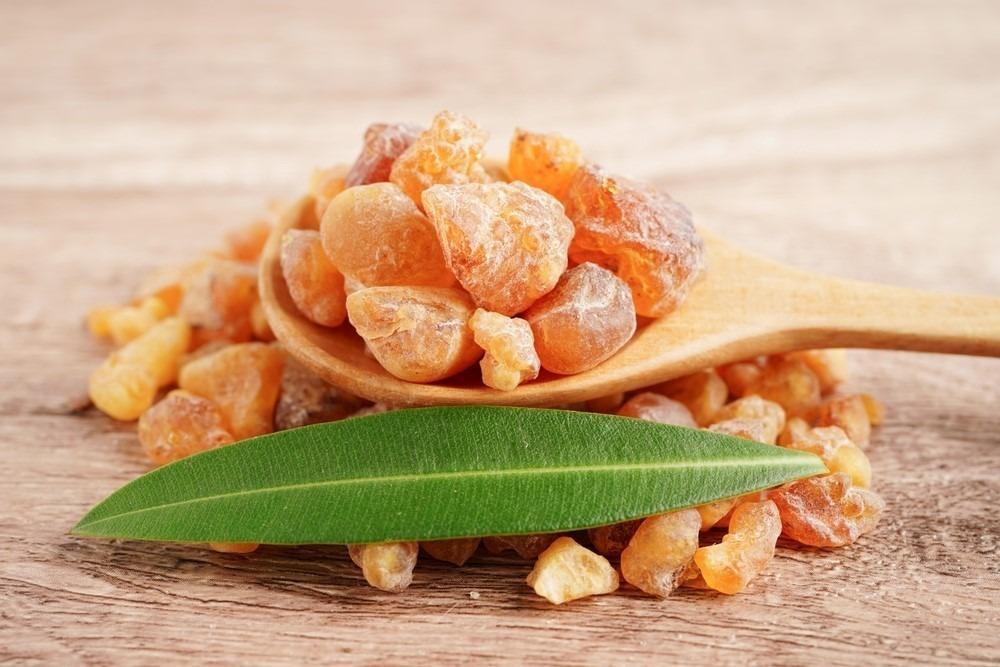
Clinical trial with K-Vie™, our proprietary Boswellia serrata extract
We evaluated a standardized extract of Boswellia serrata, K-Vie™, in randomized, double-blind, placebo-controlled clinical trials. A list of these studies is provided here.
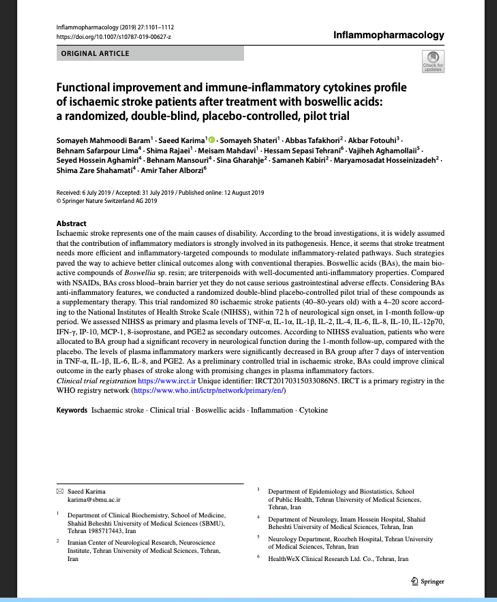
our scientists conducted a clinical study testing Boswellic acids (natural compounds derived from Boswellia serata resin and used in Kondor Phrama products) as an add-on treatment for 80 individuals with acute ischemic stroke (aged 40-80 years). For one month, patients received either boswellic acids or a placebo alongside standard stroke care. The boswellic acid group showed better neurological recovery and lower levels of inflammation-related markers in the blood (including TNF-α, IL-1β, IL-6, IL-8, and PGE2). Overall, the results suggest boswellic acids support early stroke recovery by helping reduce inflammation.
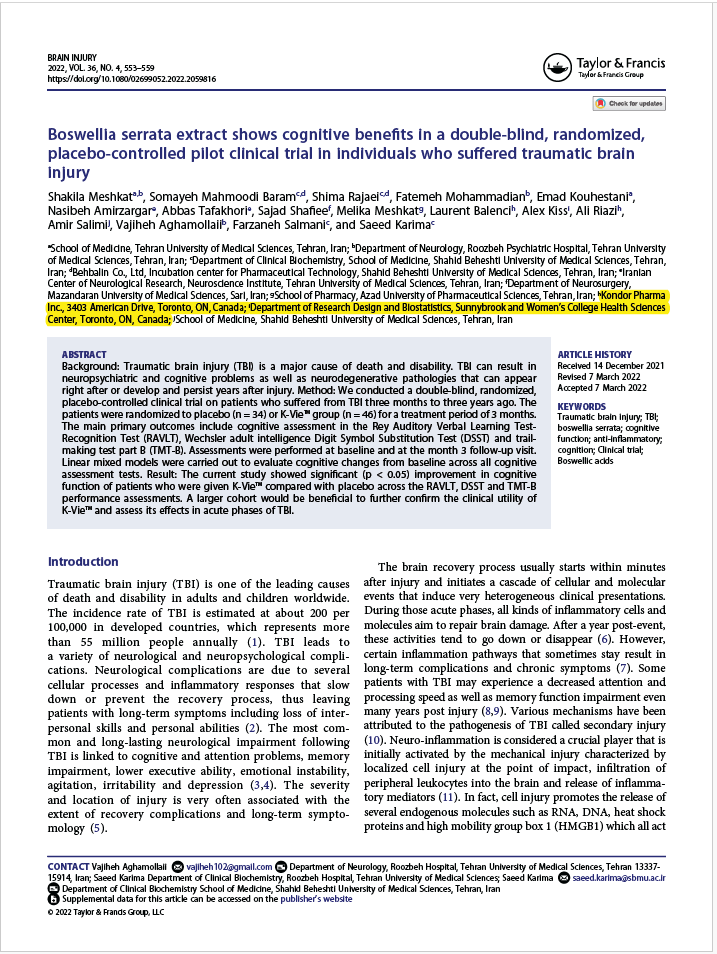
Our scientists ran a small, high-quality clinical study to see whether a standardized Boswellia serrata extract (K-Vie™) could support cognitive function in people recovering from traumatic brain injury (TBI).
Participants who had experienced a TBI 3 months to 3 years earlier took either the Boswellia extract or a placebo for three months, and their memory, attention, and mental processing speed were measured using established tests (RAVLT, DSST, and TMT-B). Compared with control, the Boswellia (K-Vie™) group showed significantly better improvement across all cognitive measures, suggesting boswellic-acid–based supplementation may help support cognitive recovery in chronic TBI.
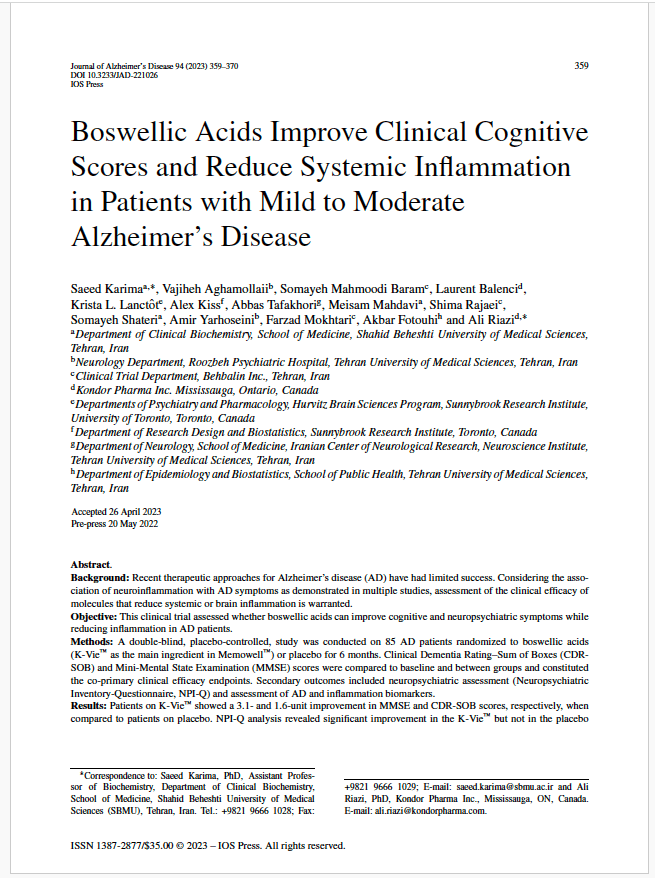
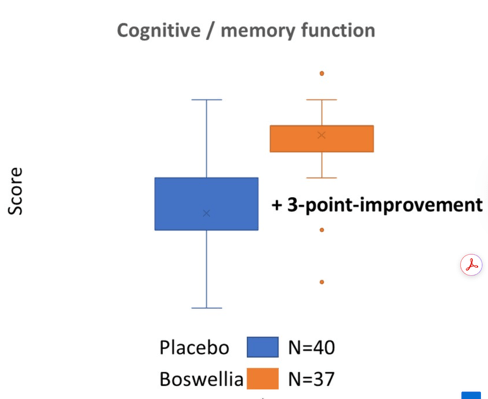
Our scientists conducted a double-blind, placebo-controlled clinical study to evaluate boswellic acids (K-Vie® as the main ingredient in Memowell®) in 85 people with mild to moderate Alzheimer’s disease over six months.
Participants received either boswellic acids or a placebo, and researchers tracked changes in cognition using standard clinical tools (MMSE and CDR-SOB), along with neuropsychiatric symptoms and blood markers of inflammation.
Compared with placebo, the K-Vie® group showed significant improvements in cognitive scores and neuropsychiatric measures, and also had lower levels of key inflammatory markers such as IL-6 and TNF-α. Overall, the findings suggest that reducing inflammation may help support better cognitive and clinical outcomes in Alzheimer’s disease.
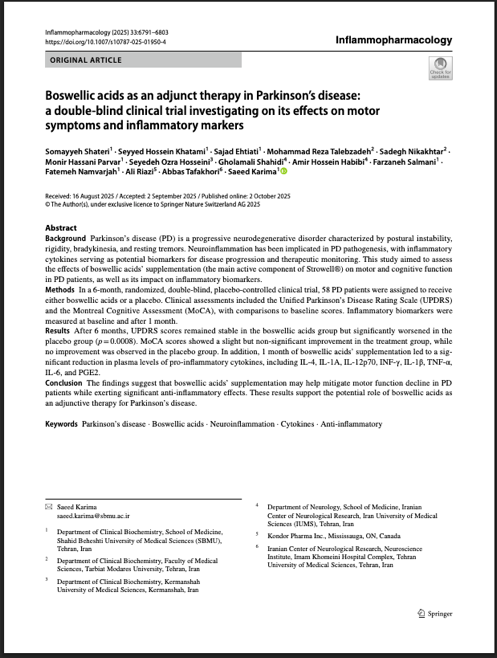
Our scientists ran a double-blind, randomized, placebo-controlled clinical study to evaluate boswellic acids as an add-on treatment in 58 people with mild to moderate Parkinson’s disease over six months.
Participants received either boswellic acids or a placebo alongside standard care, and researchers measured motor symptoms using the Unified Parkinson’s Disease Rating Scale and cognitive function using the Montreal Cognitive Assessment.
While motor scores worsened in the placebo group, they remained stable in the boswellic acid group, suggesting a protective effect against motor decline. The treatment was also linked to lower levels of several pro-inflammatory cytokines, supporting the idea that boswellic acids may help as an adjunct, anti-inflammatory approach in Parkinson’s disease.
